
Writing is the hardest language skill to learn. It takes a lot of practise and exploring to master this.
During writing, children have to think about what they want to communicate, they have to hold their pen effectively to avoid muscle pain, they have to know how to form their letters and join them to one another and they have to work out if they prefer to use their left hand or their right hand to write. Aside from all of this, they then have to know the rules and patterns of the language to spell words. They have to know how words go together to create ideas. They also have to know about other things to be able to have ideas to put into their writing. If you can imagine putting a pen in your non-dominant hand, writing Chinese script from memory and making it university standard – that would take a long time to master the necessary skills!
Click here to find out what we teach in writing at our school: Manor Road Academy Goals for writing
Teaching writing at our school begins with having a go and using marks to communicate meaning – playing at writing! If your child is yet to start school – mark make as often as you can using as many different things you can find.

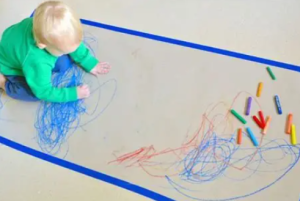
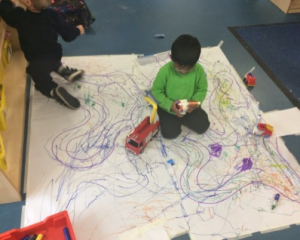
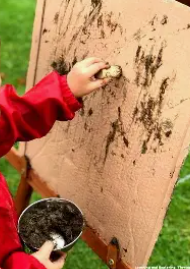
Children also need a long time to develop their muscle memory for writing. Young children’s bone structure in their hands is underdeveloped and needs lots of strength training before they will be able to master writing. This is an x-ray showing the difference between young hands and hands which are well-developed and ready to write –
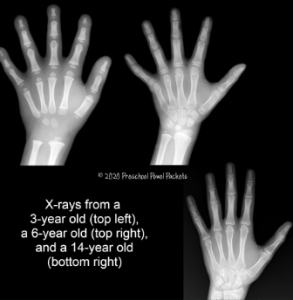
Young children need to do lots of physical activity to develop strength and muscle tone. We work on shoulder strength in order to help writing readiness. We use lots of activities such as painting, squashing and squeezing things, small world play and threading activities.
Click here to see what we teach in oracy at our school: Manor Road Academy Goals for Oracy
Children need lots of talk and practise of the language they are learning so that the language comes naturally when they start to write. We encourage lots of story reading and role-play.
Children need to see expert writers at work to help them understand what is needed. Teacher modelling and supported writing happens throughout school.
Children are taught how to form different styles of writing so that they can communicate and express themselves.
The expectation of what the children should be able to do by the time they leave our school at age 11 is set by the government. Children need to master all the skills from previous years and also demonstrate the following:
TRANSCRIPTION – SPELLING – WORKING OUT THE CODE |
I can spell correctly most words from the year 5/6 spelling list,* and use a dictionary to check the spelling of uncommon or more ambitious vocab including… |
Y3/4/5/6 key word list spelled mostly correctly – knowing some words need to be learned specifically |
Use a thesaurus to find appropriate synonyms. |
COMPOSITION – WRITING AND ORACY – USING WRITING TO COMMUNICATE AND EXPRESS |
I can write effectively for a range of purposes/audiences, selecting language showing good awareness of the reader. |
I can describe settings, characters & atmosphere. (similes, metaphor/ personification) |
I can integrate dialogue in narratives to convey character & advance the action. |
|
|
WRITING – VOCABULARY, GRAMMAR AND PUNCTUATION – ORGANISING WRITING |
I can use the range of punctuation taught at Key Stage 2 mostly correctly, including inverted commas to punctuate speech |
apostrophes for possession. |
commas after fronted adverbials. |
brackets, dashes and commas for parenthesis. |
commas to clarify meaning or avoid ambiguity. |
colon to introduce a list and use of semi-colons within lists |
I can use contracted forms in dialogues. E.g. “You shouldn’t go near the bees’ nest,” warned David. |
I can use passive voice. E.g. The story was read by the teacher. |
I can use modal verbs to suggest degrees of possibility. E.g. You must always brush your teeth. |
I can use a range of devices to build cohesion (e.g. conjunctions, adverbials of time and place, pronouns, synonyms) within and across paragraphs. |
I can use verb tenses consistently and correctly throughout writing. |
TRANSCRIPTION – HANDWRITING – TEACHING OUR MUSCLES AND PRESENTING WRITING |
I can maintain legibility in joined handwriting when writing at speed. |